This blog contains answers to exercises set for students. While every effort is made to ensure that the information posted is correct, mistakes may occur from time to time.
Search This Blog
Sunday, May 18, 2008
June 2002 PHY1
1.
C 1
A 1
B 1
E 1
2. Composition of alpha article
2 protons + 2 neutrons only 1
Explanation of ionize
Change nunber/Add/Remove electrons 1
Estimation of time alpha article would take to travel
Use of E = ½ mv2 1
Use of t = diameter/u 1
6.3 x 10^-18 s [ no ecf] 1
Explanation comparing speed of alpha and beta articles
Faster 1
Less massive/lighter/less weight (not smaller) 1
3. Explanation of essential difference between 2 definitions
Distance in direction of force against distance perpendicular to force 1
Correctly identifying which is which 1
Principle of moments
AP =80
,PB=32
[allow+ 1 ] [no ue ] 1
Demonstrate that moments are = equal. [allow any distance values] 1
Distance load at B raised
Use of work = force x distance / use of rngh [ beware m = 20 ] 1
Use of work out = work in / use of mgh lost = mgh gained 1
2.4x10 m 1
OR
Similar triangles/distance moved proportional to distance from pivot 1
x/6 x 10^-3 = 32/80 or equivalent 1
2.4x 10 m 1
4. Deceleration of cars
Acceleration = gradient / suitable eqn. of motion. 1
Correct substitutions [ 0.9 for t is wrong] 1
6.1 – 6.3 m s2[-ve value – 1] [ no ecf ] 1
Area under velocity -time graph
Distance/displacement 1
Shaded area
6.9 – 7.5 1
m 1
[Allow 1 mark for 5.5 – 6.1 cm .]
Minimum value of the initial separation
Both sloping lines continued down to time axis [by eye] 1
Explanation
Area between graphs is larger/B travels faster for longer/B still moving when A stops 1
Extra distance B goes is larger/ > 7.2 1
Initial separation must be larger 1
5. Experiment
2 light gates 1
Gate gives time trolley takes to pass [ not just ’the time’] 1
Speed = length of ’interrupter’/time taken 1
Or
2 ticker timers 1
dots at known intervals 1
speed = lenghth of tape / time taken 1
(ruler and clock method 1 mark max)
Total momentum of trolleys
Zero 1
It was zero initially or momentum is conserved [consequent] 1
Speed v of A
Use of momentum = mass x velocity 1
Use of mass x speed (A) = mass x speed (B) 1
1.8 m s -1 [ignore – ve signs] 1
6. Explanation of why kicking a door is more effective
Quality of written communication 1
Foot decelerates/ loses momentum 1
This takes place rapidly giving a large force by
Door is providing this force [consequent on mark 1] 1
Door acts on foot; by ’
7. Free-body force diagram
Normal reaction/contact force [or Nor R or push of table] upwards 1
E-M magnetic force [or magnetic attraction or pull of magnet] to right 1
Weight [or W or mg or gravitational force or gravitational attraction or pull of Earth] downwards 1
[Ignore labeled forces of action or drag] [if unlabeled – 1 each force]
Forces
Pull on earth 1
Upwards [consequent] 1
Or
Push contact / force on table 1
Downwards 1 [consequent]
Or
Force on magnet X 1
To left [consequent] 1
Precautions
Measure background radiation //shield apparatus 1
Subtract it off/ because it may vary//to eliminate background 1
Repeat the count and average 1
Because count (or emission) is random/varying 1
Source the same distance from GM on both occasions 1
Because count rate varies with distance 1 Max 3
[NB Marks must come from any TWO precautions.]
Ratio
0.88 or l. 1 [min. 2 sf] [not%] 1
Count for year 3
11 994 1
Graph
Suitable axes and scales [don’t award if factors 3, 7 used][not Bq] 1
Correct plotting of points 1
Use of curve and halving count rate 1
5.3 to 5.4 yr 1
9. Name of nuclei
Isotopes (not radioisotopes) 1
Nuclear equation
Electron numbers complete anywhere 1
Correctly balanced 1
Densest material
Sn 115 1
Monday, April 21, 2008
Thursday, February 14, 2008
y12 Physics
A coil of constantan wire of length 2 m has an area of cross-section of
7 x 10⁻⁷ m2. If its resistivity is 49 x 10-8 Ω m, find its resistance.
A coil of wire 4 m long has a resistance of 20 Ω. If its resistivity is
108 x 10-8 Ω m, find its area of cross-section.
A 1.75 m length of tin wire with a diameter of 0.70 mm is found to have a resistance of 0.5 Ω Find the resistivity of tin.
A resistor of 2 Ω is to be made from manganin wire of resistivity
42 x 10-8 Ω m having a diameter of 0.42 mm. What length is required?
Find the resistance of a wire 2.8 m long with a resistivity of 22 x 10-8 Ω m and a diameter of 0.56 mm.
A wire has a resistance of 2 Ω Find the resistance of a wire of the same material which is three times as long, but with half the diameter.
Friday, January 18, 2008
y11 Triple Sciecnce
Explain the following:
1) Nylon clothing crackles as you undress.
2) In dry weather, people walking on clean carpets may a shock if they touch a radiator
3) Passengers sliding off a car seat on to the ground sometimes get a shock
4) Petrol road tankers usually have a length of metal chain hanging down to touch the ground.
5) A rubbed balloon will stick to the wall for some time
6) A mirror or window polished by a dry cloth on a dry day may become dusty.
7) As sellotape is pulled of a roll it is attracted to your hand.
8) When spraying an object with paint, less paint is wasted if the object is charged
9) A TV screen becomes dusty
10) The amount of smoke leaving a factory can be reduced by placing a charged object in a chimney
Tuesday, January 15, 2008
y8 Joule
The oldest part of The Elms was built in 1735 for Sir Joseph Ayloffe. When it was built Acton was a small country village surrounded by fields.
How old is The Elms?
Describe the changes that have occurred in Acton since the Elms was built.
In contrast the Sports Hall was built in 1994.
We are going to look at the state of bricks in the two buildings.
The Elms
Some of the brickwork has been replaced so you must try and find an original brick.
Sketch the brick that you have chosen below.
Label features such as small holes and cracks. Is there any evidence of plant life such as moss or green/grey crusty lichens?
Look at other bricks, are they similar to the one you have drawn. Are there other features that you think are worth mentioning? Is the wear more noticeable parts of the building more exposed to the weather.
If there is time you can sketch another brick from the north side of the building.
The Sports Hall
Are any of the features seen in the bricks on The Elms visible in the bricks of the sports hall?
What reasons can you think of for the differences?
When The Elms was new do you think the bricks looked as they do now?
What could account for the change in surface of the bricks in the Elms?
Keywords
Chemical weathering, abrasion, smooth, rough, surface, cracks, flakes, breaking off, ice, snow, wind, sun, rain, heat, expansion, contraction
Tuesday, November 27, 2007
y12
The life cycle of stars
You are to produce a document to cover life cycle of stars of different masses.
You can email this to me, instead of printing.
Lots of information here http://www.astronomynotes.com/ and here http://bcs.whfreeman.com/universe6e/default.asp
Star birth
Perform a web search for giant molecular clouds, (The Eagle nebula and Orion Nebula are good examples). Insert a picture and add a caption.
“Giant molecular clouds are strung like pearls along the spiral arms of galaxies.”
Find a picture of a spiral galaxy. Hot blue stars are short lived so any we see are young. Note the blue light from the spiral arms.
Evidence of darker denser clouds can be seen in the horsehead nebula and other Barnard nebulae. Bok globules are even denser.
Protostars emit strongly in the infrared. You will find images at http://www.ipac.caltech.edu/Outreach/Edu/sform.html
Main Sequence.
There are many pictures of the sun and a search for Pleiades will give you and idea of a newly formed stellar cluster. Don’t forget the dim red ones.
The sun’s energy arises form nuclear fusion. Describe the fusion processes.
An animation may be found at this site in the chapter on the sun.
http://bcs.whfreeman.com/universe6e/default.asp
Choose animations and then complete list by chapter. There also animations on star birth you may view.
End States.
The sun will expand to a red giant before collapsing to a white dwarf (with a planetary nebula) you will find some good pictures of planetary nebulae.
Heavier stars will pass through the red giant stage before going supernova. Depending on its mass the core remnant will collapse into a neutron star or stellar black hole. The most famous supernova remnant is the crab nebula that contains a pulsar (a rapidly spinning neutron star). There are some excellent pictures of the crab and also x ray images of the neutron star which you should add to your account.
For obvious reasons there are no pictures of black holes but some excellent diagrams to look at.
Thursday, November 08, 2007
Complete the table below.

Compare the other two stars with the sun by expressing their luminosities and radii in solar units.
Betelgeuse is slightly cooler than the Sun. Is it less luminous? How can you explain this?
Compare the luminosity of Alkaid with Betelgeuse. Which is larger? How then can you account for the difference in luminosity?
Alkaid is roughly 10 times the size of our sun and 3 times as hot. How much more luminous is it? How can you account for this?
Friday, November 02, 2007
Y13 Physics Homework
Identify two significant source of error in the experiment you have described.
State in each case
i. What steps you would take to minimise the errors
ii. An estimate of the uncertainty in the measurement associated with the error.
(6 marks)
Friday, October 19, 2007
Y11 Triple Science
acceleration due to gravity = 9.8 m/s2
1. A car has a mass of 750 kg. Calculate its kinetic energy at the following velocities
(a) 10 m/s (b) 15 m/s (c) 20 m/s (d) 30 m/s (e) 35 m/s {NB 1 m/s =2 m p h}
2. (a) A car has a mass of 1000 kg. Calculate its KE at a velocity of 25 m/s.
(b) A train has a mass of 37 tonnes {1 tonne = 1000 kg}. If it also has a velocity of 25 m/s what is its kinetic energy ?
3. A woman has a mass of 65 kg.What is her GPE at the top of a 12 metre diving board ?
4. A cat has a mass of 6 kg. What is its GPE at the top of a tree that is 4.2 m above the ground ?
5. The Eiffel Tower is 300 m high. What is the GPE of a 100 g bird perched on the top of it ?
6. The Great Pyramid of Khufu (Cheops to the Greeks) is 146 m high. It is made of stones of mass 250 t. What is the GPE of the topmost stone ?
7. The Empire State Building is 449 m high(but this includes a 68 m TV mast).What is the GPE of a ball of mass 400 g at the top of the building (not the TV mast) ? If the ball is dropped over the side what will happen to the GPE ? What will be its speed at the instant before it hits the ground ? (Ignoring air resistance)
8. Olympus Mons is a volcano on Mars. It is 25 km high. What would be the GPE of a human of mass 50 kg on its summit ? (surface gravity = 0.38 that of Earth) Compare this with the same human standing on the summit of Everest 8534 m high.
9. The space shuttle has a mass of 80 t. Escape velocity (the velocity an object has to travel at in order to escape the earth's gravitational field) is 11 km/s. What is its KE at this speed? If all this KE is turned into GPE how high would it be ? What assumption do you have to make in your calculation.
How much energy would it take to accelerate the space shuttle to light speed (300 000 km/s). {This is not possible, also the equation you will use to calculate KE is not valid near the speed of light but it will do for this purpose} A nuclear power station produces around 500 MW
(500 000 000 J per second). How long would 100 power stations take to produce this amount of energy?
How feasible is travelling close to the speed of light?
The nearest star is about 4 light years away. How long would it take the space shuttle to get there at 11 km/s (22 000 mph)? {1 light year is the distance light will travel in 1 year}
How feasible is interstellar travel?
Thursday, October 18, 2007
Tuesday, October 09, 2007
y13 Physics
1. The range of sound frequencies which can be detected by a person is 17.0 Hz to 20.0 Khz. What is the corresponding range of wavelengths if the speed of sound in air is 340 ms?
2.
a) BBC Radio 4 broadcasts on a wavelength of 1.5 km what is it’s frequency?
b) What are the wavelengths of a TV station that transmits vision on 500 MHz and sound on 505 MHz?
c) What is frequency of yellow light of wavelength 0.6 mm? C= 3x10⁸ ms-1
3. The floats of two men fishing in a lake from boats are 21m apart. A disturbance at a point in line with the two floats sends out a train of waves along the surface of the water so that the floats bob up and down 20 times per minute. A man in a third boat observes that when the float of one of his colleagues is on the crest of a wave when the other is in a trough and that there is one crest between them. What is the velocity of the wave?
4. A source of sound of frequency 550 Hz emits waves of wavelength 618 mm in air at 20°C. What is the velocity of sound in air at this temperature ? What would the wavelength of sound from this source be in air at 0°C (c=330ms-1 )
Friday, September 21, 2007
y12 Physics
Mark Scheme
Knowing that the angle at T is 10 deg or 1/2 T is 5 deg (1)
Use of Tan with any angle and using 10m as base (1)
114 m (1)
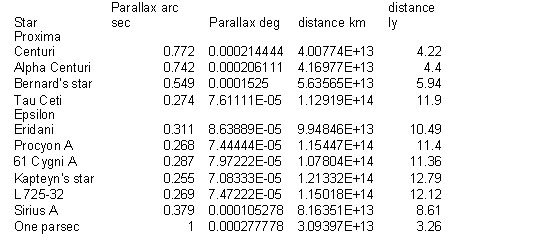
(i) (annual) parallax (1)
(ii) diameter of Earth's orbit around the sun (or on a diagram) (1)
(iii) (direction or background of more) distant stars (1)
Most stars are too distant (1)
Parallax is too small (to measure) (1) [not difficult]
This homework is now closed
Thursday, September 13, 2007
Y11 Triple Science
- 32.25 m/s
- 13.33 m/s
- 15 m/s
- 0.5 m/s
- 39 600 m (39.6 km)
- 612 km No the moon orbits the Earth
- 9.4 x 10 15 s 1 year from the point of view of someone on Earth, but from your point of view no time has elapsed.
- 8.57 million years
- 7.5 s (yes it's Gazpacho)
- 16.67 s
- 9.09 s compared to 6.52 s. anaeorbic respiration cannot carry you 1500 m.
- 0.476 s
The Steady Earth
i 1674.4 km/h 465 m/s Garvity, no as we have less far to travel. Theoretically zero.
ii 6822 km/h The tilt of the Earth
iii 1993.7 s (33 min)
iv 6000km but then I am quicker than you.
Y11
5 (6 – 0)/(5 – 2) = 2 m/s2, (0 – 6 )/(12 –10) = –3 m/s2
6 Gradient = vertical increase/horizontal increase. For a velocity–time graph the vertical increase is the increase in velocity,and the horizontal increase is the time taken for this to happen.
7 The velocity has a positive value when the ball is going down.
8 The points where the sloping line crosses the time axis are where theball is at the top of its bounce.
9 The line would be getting steeper.
Saturday, May 19, 2007
Sunday, May 13, 2007
Wednesday, May 09, 2007
y10
1 Mercury (as well as extreme heat), Mars, Jupiter, Saturn, Uranus, Neptune and Pluto.
2 Mercury and Venus have
temperatures greater than that on the Earth.
3 Jupiter, Saturn, Uranus and Neptune – because they are ‘gaseous’ planets.
4 Venus: The planet has a thick highpressure atmosphere (enough to crush us), very high temperatures and its atmosphere has clouds of
sulphuric acid (so the rain would be acid!).
5 Europa has evidence of water – which is essential for life.
6 Reduced fuel costs as there is less effort to escape a planet’s or moon’s gravitational pull. It would also be cheaper to re-supply the hotels too, for the same reason.
7 Open-ended research question.
Tuesday, May 08, 2007
y10
H5 Centripetal force and the
solar system
1 Rocky/circular orbit/much smaller than a planet
(less than 1000 km).
Any two. 2
Total 2
2 (a) Ellipse. 1
(b) When it is near the Sun. 1
(c) Frozen ice and rock. 1
Total 3
3 (a) The force of gravity 1
between Mars and the Sun. 1
(b) The force of gravity 1
between the comet and the Sun. 1
(c) The force of gravity 1
between the Moon and Earth. 1
Total 6
4 (a) Centripetal. 1
(b) (i) The tension in the string. 1
(ii) Friction between tyre and road. 1
(iii) The gravitational force between the
satellite and Earth. 1
Total 4
5 (a) Arrow from centre of the Moon pointing towards
the centre of Earth labelled force of Earth on
the Moon. 1
Arrow from centre of Earth pointing towards the
centre of the Moon labelled force of the Moon
on Earth. 1
(b) Both forces have the same size 1
and act in opposite directions. 1
(c) Answers involving the idea that the two forces
are not acting on the same body (e.g. Earth only
experiences one of the forces, the Moon
experiences the other force only). 1
Total 5
Monday, April 30, 2007
y11 chemistry homework
processes
1 (a) £83 799 2
Allow one mark for 235 . 200 + 5257 . 7
(b) (i) £17 007 1
(ii) £340.14 1
(iii) Any two from: transport cost/research and
development/depreciation/import/export
duty/taxes/loans/packaging/advertising. 2
(c) (i) £11 132 1
(ii) £445.28 1
(iii) The unit cost is less when more is made
per day. 1
Total 9
2 (a) A reaction that can change reactants into products
and the products back into the reactants. 1
(b) Correct data selected and plotted (only those at
100 atmospheres) 1
Suitable scale and labelled axes 1
Best-fit curve. 1
(c) Correct data selected and plotted (only those at
150°C) 1
Sensible scale and axes labelled. 1
Best-fit curve. 1
(d) Increases 1
(e) Decreases 1
(f) (i) Increases since there are more energetic
collisions/increases because there are more
collisions per second. 1
(ii) Increases because there are more collisions
per second. 1
Total 11
Wednesday, April 11, 2007
Y13
http://www.edexcel.org.uk/VirtualContent/48956/GCE_Physics_6736_epen_Exemplar_Markscheme.pdf
Friday, March 30, 2007
Y12 Homework on Radioactivity
Nuclear Physics
1. Radon has a proton number of 86 and a nucleon number of 220. It emits an α-particle to become Thorium A (polonium), which emits another α particle to become Thorium B (radioactive lead). Thorium B then emits a β-particle to become Thorium C (bismuth). What is (a) the proton number and (b) the nucleon number of Thorium C?
2. When a Boron nucleus 105B is bombarded with a neutron a nucleus of Lithium 73Li, is produced, together with another particle. What are the proton number, the nucleon number and the name of this particle?
3. A ’snap-shot’ photograph of a cloud chamber shows 40 well-defined alpha particle tracks. A second ’snap-shot’ taken 2 min later shows only 10 tracks. What is the half-life of the alpha source?
4. A lead container has a narrow slit and sources inside emit α, β and γ rays. A powerful magnetic field is applied. Draw a labelled sketch to show what happens – the rays emerge vertically upwards in the plane of the paper and the field is applied so that the flux passes at right angles into the plane of the paper.
5. A Geiger-Muller tube connected to a rate meter is held near a radio-active source. The corrected count rate (allowing for background count) is 400 Bq. 40 min later the corrected count rate is 25 Bq. What is the half-life of the source?
6. A rate meter records a background count rate of 2 Bq. When a radioactive source is held near the count rate is 162 Bq. If the half-life of the source is 5 min, what will the recorded count rate be 20 min later?
7. A patient suffering from cancer of the thyroid gland is given a dose of radioactive iodine 131, with a half-life of 8 days, to combat the disease. He is temporarily radioactive and his nurses must be changed regularly to protect them. If his radioactivity is initially 4 times the acceptable level, how long is it before the special nursing rota can be dropped?
8. An experiment to determine the half-life of a radioactive gas using a Geiger-Muller tube and a rate meter gave the following results:
Background count rate; 1 Bq
Time/s
0
20
40
60
80
100
120
140
160
Recorded count rate/Bq
71
55
43
34
26
20
16
12
10
Plot a graph and estimate the half-life of the gas.
9. Thoron gas was introduced into a ’decay chamber’ attached to a pulse electroscope. The times at which successive pulses occurred were recorded, giving the following results:
Pulse number
1
2
3
4
5
6
7
8
9
10
Time/s
8
17
28
40
55
75
100
135
200
500
Draw a ’pulse number-time’ graph and estimate the half-life of Thoron.
10. An ionisation chamber was connected to a pulse electroscope and an alpha source held near it. Beyond a certain distance no pulses were produced. For smaller distances the pulse rate varied as follows:
Distance from source /cm
0.5
1.0
1.5
2.0
2.5
3.0
3.5
4.0
4.5
Number of pulses per min
100
90
68
44
26
14
8
4
1
Plot a graph and estimate the range of the alpha particles.
Thursday, February 15, 2007
Tuesday, January 30, 2007
Y11 Boron
H10 Working with nuclear
radiation
1 (a) Axes labelled correctly, 1
plots correct. 2
Deduct one mark per mistake up to a maximum of 2.
(b) Nuclear power stations have had a negligible
effect on the amount of background radiation. 1
(c) Radiation constantly present around us. 1
(d) (i) Space. 1
(ii) Rocks/soil. 1
(iii) Soil. 1
(iv) Rocks. 1
Total 9
2 (a) A charged atom or molecule. 1
(b) The ray strips an electron from an atom, leaving
it positively charged. 1
The electron attaches to a nearby atom making
it negatively charged. 1
Total 3
3 (a) Cooling water/laboratory equipment/used
protective clothing.
Any one. 1
(b) (i) If the waste got wet the water would
become radioactive 1
and end up in streams, rivers, wells, the
water table, 1
where it would affect plants and animals
(including humans). 1
(ii) Clay is impervious to water. 1
(c) (i) 24000 years. 1
(ii) 48000 years. 1
Total 7
4 Tracers/radiotherapy/sterilising medical
equipment/radioactive dating/measuring thickness.
Any two. 1
Total 1
Friday, January 26, 2007
y12 Homework on Resistors in Series and Parallel
series 55 parallel 5
series 10 parallel 2.4
series 29 parallel 2
A series circuit has only one current path and the potential has to be divided between the components. As a result the current is low and therefore by Ohm’s law the resistance is high.
A parallel circuit has one current path for each resistor and each has the same. As a result the current is high and therefore by Ohm’s law the resistance is low.
12.9
series 10 parallel 6
A&B 1.6 B&C 2.1 A&C 2.5
Extra 12 and 8
This homework is now closed
Tuesday, January 09, 2007
Y9 Bream Homework
1. Why do stiletto heels damage floors?
Stiletto heels have a very small surface area. As a result the person’s weight is spread over a small area and there is high pressure exerted on the floor
2. Why is thick padding added to the straps of some rucksacks?
The padding increases the area of the straps. The weight of the rucksack is spread over a larger area. This reduces the pressure exerted on the person’s shoulders.
3. Why do bulldozers have caterpillar tracks?
This increases the area in contact with the soft ground. The large weight of the bulldozer is spread over a larger area so there is less pressure and the bulldozer is less likely to sink into the mud.
4. Why do loaded plastic shopping bags dig into your hands?
The surface area in contact with your hand is small. The weight of the shopping in the bag is concentrated over a small area so the pressure on your hands is high
5. Why do knives cut?
The blade of a knife has a small area. When you push down on the knife the force is concentrated on a small area. This produces a very large pressure under the blade.
6. What do you do when you sharpen knives?
The area under the blade is made smaller increasing the pressure exerted by a force of the same size.
7. Why must workmen walk on ladders on top of a weakly constructed roof?
The area of the ladder in contact with the roof is large. This spreads out the weight of the workman exerting a low pressure on the roof.
8. Why do some heavy lorries have 8 rear wheels?
The weight of the lorry is spread over a lager area exerting a lower pressure on the road
9. Why can an Indian Fakir lie on a bed on nails if it contains a large
number of nails ?
The surface area of a large number of nails is high. The weight of the fakir is spread over a large surface area. The pressure exerted by each single nail is low.
10. Why is it less painful for small children to walk barefoot on pebbles than it is for adults?
The child weighs less than the adult. As a result the pressure exerted by a single pebble of the same area is lower on the foot of a child than the foot of an adult
Monday, November 27, 2006
y12 mark scheme
Topic A - Astrophysics
(a)
H-R Diagram
L and T
L and K
[or L and L , T and K , not W]
Any 2 correct [of 102, 1 or 100, 10−2]
All 3 correct
20 000 and 5 000
(iv) Identify stars
Red giant = (B and) C
Low mass ms star = E [ignore X]
2
(v) Zeta Tauri Luminosity
Use of L = 4 π D2 I
Correct substitution
3.8(2) × 1030 (W) 3
(vi) Zeta Tauri identification (ecf)
3.8(2) × 1030 W ÷ 3.9 × 1026 W [or 4 × 1030 W used]
Correct ratio [e.g. 9700, 9800, 10300 or 104, etc.]
Hence A [from answer in range 9700 to 10300]
3
(b)
Fusion calculations
Mass difference substitution [(2 × 5.0055) – (6.6447 + 2 × 1.6726)]
2.11 × 10⁻²⁹ kg [or 0.0211 × 10⁻²⁷ kg]
E = mc2 seen
1.9 × 10⁻¹² J [ecf]
2
2
(c)(i)Pulsars
Neutron star
Core remnant
Supernova
1.4 [accept 0.4 and 1.4]
4
(ii) (iii)
Binary pulsar system
Quality of written communication
(Varying) radio signals
(Regular) pulses detected [like lighthouse]
Idea of two overlapping pulses (from same location) 4
Black hole
1
(d)
White dwarf density
M ÷4/3 π r3 [allow M, m, R, r] 1
Any pair of values correctly read [may be implied, ignore 106]
Any correct substitution [with 2.0 × 1030 and 106, ecf on (i)]
Two correct answers [in kg m-3, no statement required]
White dwarf future
Cools / temperature decreases 3
Becomes dimmer / changes colour [not brown dwarf] 1
Total 32
Monday, October 16, 2006
y12 Physics
Begin a new document.
Import a detailed diagram of the electro magnetic spectrum. (Use a web search)
Use Wien’s Law to calculate the temperature of the extreme edges of each band. ( If you haven’t got a calculator use the computers or Excel)
λ max x T = 2.898 x 10⁻³ mK
We cannot observe the whole spectrum from the ground due to absorption by the Earth’s atmosphere.
Insert a diagram of the Atmospheric Window and make relevant notes.
Useful site (http://freespace.virgin.net/gareth.james/index.htm#)
To observe in the microwave, infrared, ultra violet, X and Gamma ray bands we have to use satellites.
Find out about the following missions, what they observed and how useful they were.
The Hubble Space Telescope (http://hubblesite.org/)
IRAS (http://www.nasm.si.edu/nasm/dsh/artifacts/SS-IRAS.htm)
COBE and WMAP, (http://map.gsfc.nasa.gov/ http://aether.lbl.gov/www/projects/cobe/ )
XXM Newton ( http://xmm.vilspa.esa.es/ ) and
Chandra ( http://chandra.harvard.edu/ )
Tuesday, October 10, 2006
Y10 Hw on Meters
H3 Meters
1 (a) Correct diagram showing motor connected
to battery. 1
(b) Correct diagram showing ammeter in series
with motor and battery. 1
(c) ‘+’ sign label on side of ammeter nearest to
long bar of battery symbol. 1
(d) Correct diagram showing voltmeter in parallel
with motor. 1
(e) ‘+’ sign label on side of voltmeter nearest to
long bar of battery symbol. 1
Total 5
2 (a) (i) 1.2V 1
(ii) 1.2V 1
(b) (i) 1.2V 1
(ii) 1.2V 1
(c) (i) 1.2V 1
(ii) 1.2V 1
Total 6
3 (a) (i) 1.5V 1
(ii) 1.5V 1
(b) Electric current. 1
(c) Amps (amperes). 1
(d) (i) 1A 1
(ii) 1A 1
(e) I = Q/t = 5/20 1
= 0.25A 1
(f) Charge/charged particles/current carry
energy with them. 1
F3 Meters
1 (a) 2.6 1
A 1
(b) 3 1
A 1
(c) 3.5 1
A 1
Total 6
2 (a) 0.6A 1
(b) 0.6A 1
Total 2
3 (a) 0.6A 1
(b) 0.6A 1
Total 2
4 (a) 0.3A 1
(b) 0.3A 1
Total 2
5 (a) Correct diagram showing motor connected
to battery. 1
(b) Correct diagram showing ammeter in series
with motor and battery. 1
(c) ‘+’ sign label on side of ammeter nearest to
long bar of battery symbol. 1
(d) Correct diagram showing voltmeter in parallel
with motor. 1
(e) ‘+’ sign label on side of voltmeter nearest to
long bar of battery symbol. 1
Total 5
6 (a) 1.2 1
V 1
(b) 1.2V. 1
Wednesday, September 27, 2006
Y11 Homework on electric motors
1 (a) (i) From N pole to S pole. 1
(ii) No effect. 1
(iii) The wire moves 1
vertically/at right angles to the field. 1
(iv) The wire moves in the opposite direction. 1
(v) Wire moves faster/more force on wire. 1
(vi) No effect. 1
(b) (i) Using your left hand point first finger in the
direction of the magnetic field 1
point second finger in the direction of
the current. 1
The thumb points in the direction of
motion (force). 1
(ii) The wire moves upwards. 1
(iii) The force on the wire is upwards. 1
Total 12
2 (a) N pole to S pole/left to right. 1
(b) Field and wire are at right angles/90°. 1
(c) (i) Upwards. 1
(ii) Downwards. 1
(d) The coil rotates. 1
(e) The commutator and brushes allow current to
flow through the coil during rotation, 1
the commutator reverses the current every
half cycle, 1
so rotation continues in the same direction. 1
Total 8
Friday, September 22, 2006
Y13 Wave Equation
1 0.17 to 20m
2 200 kHz, 0.6 and 0.59m, 5 exp 14 Hz
3 F = 20/60, 3/2wavelength = 21m so w = 14m, v= 4.67 ms-1
4 339.9 ms-1, 0.6m
This homework is now closed
Monday, September 18, 2006
y10 Homework
H1 Simple electric current
1 (a) (i) Positive. 1
(ii) Negative. 1
(b) Complete circuit. 1
Current/charge flow. 1
Energy transfer from battery to motor.
Total 5
2 (a) Electrons not stuck to any particular atom. 1
(b) From negative to positive. 1
(c) From positive to negative. 1
(d) The direction of conventional current flow is
from positive to negative (the direction of +ve
charge flow). 1
(e) (i) Lamp connected to cell in complete loop. 1
(ii) Long bar of cell symbol labelled ‘+ve’,
short bar labelled ‘–ve’. 1
(iii) Electron flow labelled from negative
to positive. 1
(iv) Conventional current labelled from positive
to negative. 1
Total 8
3 (a) (i) A charged particle (atom, molecule). 1
(ii) Positive. 1
(iii) Negative. 1
(b) (i) Electrodes and electrolyte connected to cell
in complete loop. 1
(ii) They move towards cathode
(accept negative electrode). 1
(iii) They move towards anode
(accept positive electrode). 1
(iv) Electrons. 1
Total 7
H2 Series and
parallel circuits
1 (a) A, B, C. 1
(b) C, F. 1
Total 2
2 (a) If one lamp stops working, the other lamp will
still work. 1
(b) If one lamp stops working, all the other lamps
stop working too. 1
(c) In parallel. 1
Total 3
3 (a, b, c) Circuit drawn correctly with lamps in parallel. 1
Switch A in the same branch as lamp A. 1
Switch B in the same branch as lamp B. 1
(d) Circuit drawn correctly with a simple switch
between the cell and the junction where
the wires branch. 1
Total 4
4
switch A off off off off
(on or off)
switch B off on off on
(on or off)
‘mains is connected’ on on on on
(on or off)
motor to turn drum off off on on
(on or off)
Heater off off off on
(on or off)
marks 1 1 1 1
Total 4
5 (a) (i) The lamp is brighter than normal. 1
(ii) The lamp is at normal brightness.
(b) (i) 3V. 1
(ii) 1.5V. 1
(c) Parallel. 1
Total 5
6 (a) Diagram showing two cells in parallel. 1
(b) Diagram shows floppy disk drive in parallel
with computer. 1
CD-ROM drive in parallel with computer. 1
Total 3
Monday, September 11, 2006
Y11 boron
1 (a) Attracts. 1
(b) No effect. 1
(c) Repels. 1
(d) Attracts. 1
Total 4
2 (a) Diagram should have correct ‘butterfly’ shape
with lines starting and ending on the poles and
not crossing each other. 1
(b) The lines are close together where the field
is strongest. 1
(c) (i) Arrows pointing along lines from N pole
to S pole. 1
(ii) The direction is the one along which a
compass needle points, 1
or the direction in which an isolated
N pole would move. 1
Total 4
3 Magnetic field lines between the magnets parallel
and evenly spaced. 1
Arrows point from N pole to S pole. 1
Total 2
4 (a) (i) Opposite geographic north pole. 1
(ii) Opposite magnetic north pole. 1
(b) Towards Earth’s north pole. 1
(c) (i) Bar magnet drawn inside Earth along line
joining magnetic north and south poles. 1
Field lines should have same shape as
‘butterfly’ pattern of on magnet. 1
Arrows should point from bar magnet’s N pole
(Earth’s magnetic south pole) to the bar
magnet’s S pole. 1
(ii) N pole of bar magnet near to Earth’s
south pole. 1
(iv) There is not a bar magnet inside Earth. 1
The centre of earth is very hot 1
and a magnet would melt/its magnetism
destroyed by heat. 1
Total 10