1 0.21K
2 94.5K
3 20m
4 150m
5 0.294K
6 360 000J (360kJ)
7 240 000J (240kJ)
8 14K
9 350 ms-1
Monday, March 27, 2006

Tuesday, March 14, 2006
Latent Heat Answers
1. 25 860 J
2. 60 120 J
3. 4200J
4. 0.048 kg
5. Space = steam at 100 deg
Cloud of steam = condensed stem ie water vaopur at a lower temp, as heat has been lost it condenses.
6. 562.5 s
7. 2.25 x 10E6 Jkg-1
8. 387 s
9. 335 000 Jkg-1
10. 336 000 Jkg-1
11. ditto
12. 1.02 x 10E6 Jkg-1
Apologies for formatting
This homework is now closed
Wednesday, March 08, 2006
Y12 Homework
Pressure in Fluids
A dam is 200 m long and 20 m deep. Find the total force exerted by the water on the dam.
A vertical tube 0.80 m long is one-quarter full of mercury of density 13 600 kg m-3 and three-quarters full of paraffin of density 800 kg m-3. What pressure do the liquids at the bottom of the tube exert?
The height of the mercury barometer is 750 mm. If the density of mercury is 13 600 kg m-3, what is the atmospheric pressure? (atmospheric pressure holds up the mercury)
A vertical U-tube contains a column of water balanced by a column of paraffin. (draw a diagram) The top of the water column is 0.40 m above the common level and the top of the paraffin column is 0.50 m above the common level. (ie their weight is equal) What is the density of paraffin?
If the mercury barometer reads 760 mmHg, find the atmospheric pressure in millibars. The density of mercury is 13 600 kg m-3 and 1 mbar = 10 N m -2.
A mercury barometer reads 758 mm at sea level and 708 mm at the top of a mountain. If the density of mercury is 13 600 kg m-3 and the average density of the air is 1.25 kg m-3, what is the height of the mountain?
Thursday, March 02, 2006
y12 Homework
Latent Heat
Latent Heat of fusion of ice = 3.36 x 10⁵ J kg-1
Latent Heat of vaporization of water = 2.25 x 10⁶ J kg-1
Specific heat capacity of water = 4200 J kg-1 K-1
How much heat energy is needed to change 0.010 kg of water at 20oC to steam at 100oC?
How much heat energy is needed to change 0.020 kg of ice at 0°C into steam at 100°C?
How much heat energy is needed to melt 0.010 kg of ice at 0o C and then heat the water formed to 20o C?
What mass of ice at 0 °C is needed to cool 0.086 kg of water from 54 °C to 6 °C?
When a kettle boils a space can be seen between the spout and the so called `cloud of steam'. If your finger were placed in the space a much more serious scald would result than if it were placed in the `cloud of steam'. Explain why, and criticize the expression `cloud of steam'.
A heating coil takes 14 min to heat 0.20 kg of water from 20 °C to boiling point. How much longer will it take to boil away 0.02 kg of the boiling water?
A 1 kW immersion heater takes 225 s to boil away 0.1 kg of water at 100 °C. Find the specific latent heat of vaporization of water.
How long will it take an immersion heater of power 500 W to boil away a mixture of 0.05 kg of water and 0.02 kg of ice initially at 0 °C?
A mixture of ice and water at 0 °C contains 0.060 kg of ice. A 750 W immersion heater takes 26.8 s to melt all the ice. Deduce a value for the specific latent heat of fusion of ice.
A mixture of ice and water at 0 °C has a total mass of 1 kg, and contains 0.5 kg of ice. An immersion heater melts all the ice in 168 s, and then needs a further 84 s to heat the mixture to 20 °C. Find the specific latent heat of fusion of ice.
A vessel of heat capacity 115 J K-1 contains 0.30 kg of water and 0.20 kg of ice at 0 °C. An immersion heater takes 134.4 s to melt the ice and a further 88.6 s to heat the vessel and its contents to 20 °C. Find the specific latent heat of fusion of ice.
A heating coil takes 115 s to heat 0.05 kg of a liquid from 20 °C to its boiling-point of 80 °C. It needs a further 340 s to boil away 0.02 kg of the liquid. If the specific heat capacity of the liquid is 2300 J kg-1 K-1, find its specific latent heat of vaporization.
Friday, February 24, 2006
Y12 assessment mark scheme
6732 Unit Test PHY2 June 2004 (electricity only)
1. Charge
Charge is the current x time ü ( Where you see this symbol there is supposed to be a tick) 1
Potential difference
Work done per unit charge [flowing] ü 1
Energy
9V x 20C ü
=180J ü 2
Total 4
2. Number of electrons
(-64 x 10-9C)/(-1.6 x 10-19 C) = 4.0 x 10¹¹ electrons
Use of n = Q/e ü
Seeing 1.6 x 10⁻¹⁹ C ü
Answer of 4.0 x 10¹¹ (electrons) ü 3
[Use of a unit is a ue] [-ve answer: 2/3]
Rate of flow
(6.4 x 10⁻⁸ C)/3.8 s = 16.8/17 [uC s-1] OR 16.8/17 x 10-9 [C s-1]
(6.4) / 3.8 s i.e. use of I = Q / t [Ignore powers of 10] ü
Correct answer [No e.c.f] [1.7 or 1.68 x 10⁻⁸ or 1.6 x 10⁻⁸ ü 2
Unit
Amp(ere)/A ü 1
Total 6
6 Explanation of observation
Any two from:
- LED on reverse bias/R in LED infinite/ LED wrong way round
- so current is zero /LED does not conduct / very small reverse bias current
- since V = IR.
- V=0x1K=0V üü
Explanation of dimness
Rv very large / Rv much greater than RLED
Current very low / pd across LED very small (not zero) üü 2
Circuit diagram
LED in forward bias ü
Variation of pd across LED ü
Voltmeter in parallel with LED alone ü 3
(LED in series with voltmeter 0/3]
total 7
7. Circuit diagram
Ammeter in series with cell and variable resistor (correct symbol) ü
Voltmeter in parallel with cell OR variable resistor ü 2
Power output at point X
Power = voltage x current ü
=0.45V x 0.6A
= 0.27 W ü 2
Description of power output
Any three from:
Current zero; power output zero/small/low
• As current increases power output also increases
• Then (after X ) power decreases
• Maximum current; power output zero ü ü ü 3
[Accept reverse order]
e.m.f. of cell
0.58 V ü 1
Internal resistance
Attempt to use " lost volts" OR E = V + IR current ü
_ 0.58V-0.45V 0.6 A
= 0.217 / 0.2 ohm ü 2
[ecf an emf greater than 0.45 V]
Total 10
8 Statement 1
Statement is false ü
Wires in series have same current ü
Use of I = nAev with n and e constant ü
[The latter two marks are independent] 3
Statement 2
Statement is true ü
Resistors in parallel have same p.d. ü
Use of Power = V2/R leading to R inc, power dec ü
OR as R inc I dec leading to a lower value of VI
3rd mark consequent on second 3
total 6
Year 9 Global Warming
Global Warming
The Earth receives a constant supply of energy from the sun which is 150 million km away in the form of electromagnetic radiation. We can measure the amount of energy we receive from the sun and use that to calculate what the average surface temperature of the Earth should be. Surprisingly this gives an answer of –17C. We measure the average temperature to be +9C. What’s wrong.
Actually nothing. It’s the greenhouse effect that increases our temperature.
What is the greenhouse effect?
The surface of the sun is about 6000C. This means the em rays have a short wavelength. They heat the earth up. The Earth at 9C is much hotter than space so it also gives out radiation. The Earths em rays have a longer wavelength than the sun’s.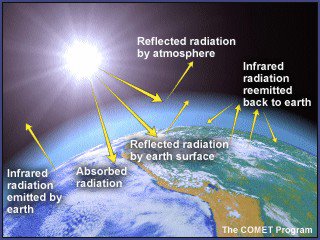
The Greenhouse gases
Carbon Dioxide, Water Vapour, Methane
The short waves from the sun do not interact with the molecules of these compounds, but the longer waves emitted by the Earth’s surface hit these molecules and make them vibrate. This makes them unstable so after a short while they re emit a low wavelength infra red ray. Some of these head back to Earth. So the Earth loses less heat than it should do. (This is correct; heat is not reflected back from the greenhouse gases)
We wouldn’t be here without the greenhouse effect so what’s the problem?
This graph shows the increase in CO2 since the industrial revolution. Next to it is a graph of the average temperature of the Earth over the same period.


Should we worry?
The Earth’s climate is unstable and has varied much in the recent past. We are at present in an Interglacial period.

It is possible that the present rise is linked to this. Recent studies however suggest that an increase in CO2 is causing an increase in global average temperatures.
Climate change for whatever reason could be disastrous for our current civilisation. Melting polar ice caps could trigger sea level rise. Bizarrely it could make the UK much colder. Changing rainfall patterns could affect global crop production and industrial processes require vast amounts of water.
The effects of a hotter planet would affect the natural world, but the Earth has been much hotter in the distant past and there is evidence that it froze over completely at least once in its history.
Questions.
What is the Earth’s major source of energy?
What should the Earth’s surface temperature be? Why is the greenhouse effect good?
What are the three major greenhouse gases and where do they come from?
Draw a diagram of the earth. Draw in the atmosphere. Show the waves from the sun and earth. Add on the re radiated infra red to show the greenhouse effect.
Why do people worry about CO2 in the atmosphere?
Has the Earth’s climate been stable in the past?
Why do some people feel that the CO2 we release into the atmosphere is nothing to worry about and global warming has other causes?
Why do people worry about climate change?
What, if anything, can you do?What should our government do?
The Earth receives a constant supply of energy from the sun which is 150 million km away in the form of electromagnetic radiation. We can measure the amount of energy we receive from the sun and use that to calculate what the average surface temperature of the Earth should be. Surprisingly this gives an answer of –17C. We measure the average temperature to be +9C. What’s wrong.
Actually nothing. It’s the greenhouse effect that increases our temperature.
What is the greenhouse effect?
The surface of the sun is about 6000C. This means the em rays have a short wavelength. They heat the earth up. The Earth at 9C is much hotter than space so it also gives out radiation. The Earths em rays have a longer wavelength than the sun’s.

The Greenhouse gases
Carbon Dioxide, Water Vapour, Methane
The short waves from the sun do not interact with the molecules of these compounds, but the longer waves emitted by the Earth’s surface hit these molecules and make them vibrate. This makes them unstable so after a short while they re emit a low wavelength infra red ray. Some of these head back to Earth. So the Earth loses less heat than it should do. (This is correct; heat is not reflected back from the greenhouse gases)
We wouldn’t be here without the greenhouse effect so what’s the problem?
This graph shows the increase in CO2 since the industrial revolution. Next to it is a graph of the average temperature of the Earth over the same period.


Should we worry?
The Earth’s climate is unstable and has varied much in the recent past. We are at present in an Interglacial period.

It is possible that the present rise is linked to this. Recent studies however suggest that an increase in CO2 is causing an increase in global average temperatures.
Climate change for whatever reason could be disastrous for our current civilisation. Melting polar ice caps could trigger sea level rise. Bizarrely it could make the UK much colder. Changing rainfall patterns could affect global crop production and industrial processes require vast amounts of water.
The effects of a hotter planet would affect the natural world, but the Earth has been much hotter in the distant past and there is evidence that it froze over completely at least once in its history.
Questions.
What is the Earth’s major source of energy?
What should the Earth’s surface temperature be? Why is the greenhouse effect good?
What are the three major greenhouse gases and where do they come from?
Draw a diagram of the earth. Draw in the atmosphere. Show the waves from the sun and earth. Add on the re radiated infra red to show the greenhouse effect.
Why do people worry about CO2 in the atmosphere?
Has the Earth’s climate been stable in the past?
Why do some people feel that the CO2 we release into the atmosphere is nothing to worry about and global warming has other causes?
Why do people worry about climate change?
What, if anything, can you do?What should our government do?
Monday, February 20, 2006
Answers to Y12 Hw on Base Units
Watt kg m2 s-3 (Power=Work/time)
Hz s-1
Coulomb As
Ohm kg m2 s-3 A-2
Volt kg m2 s-3 A-1
Apologies for the formatting
This homework is now closed
Hz s-1
Coulomb As
Ohm kg m2 s-3 A-2
Volt kg m2 s-3 A-1
Apologies for the formatting
This homework is now closed
Thursday, February 02, 2006
Y13 Assessment
This will take place on
Wednesday 22nd February Period 5
Topics covered Electric Fields and Capacitors, Magnetic Fields.
Wednesday 22nd February Period 5
Topics covered Electric Fields and Capacitors, Magnetic Fields.
Tuesday, January 31, 2006
Internal Resistance

Internal Resistance
Q 1,2 & 3 Look up the answers in your text books.
Q4 Total R = 2 + 5.5
I = 1.5 V/Total R
Pd across cell = pd across external R = I(5.5) = 1.1V
Q5 emf = 1.5V
Lost volts = (1.5 – 1.2) V
Internal r = lost volts/0.30A = 1.0 ohm
External R = 1.2V/0.30A = 4.0 ohm
Q6 lost volts = 100A (0.04 ohm) = 4V
Only 8V across external circuit so bulbs are dim
Q7 I=V/R= 1.25V/25 ohm = 0.05A
Internal r = lost volts/I = 0.25V/0.05A = 5 ohms
Total R with 10 ohm = 10 + 5 =15
I = E/R = 1.5/15 = 0.1A
V across terminals= V across 10 ohm R = 0.1A(10 ohm) = 1V
This homework is now closed.I will run an extra session on this when the school re opens.
Subscribe to:
Posts (Atom)